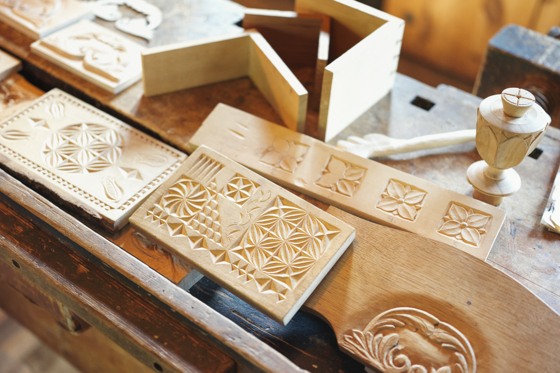
About Chip Carving
Chip carving is an ancient technique used to decorate surfaces with carved patterns, mainly on wood but also on horn, metal, and leather. The technique has existed since prehistoric times and has been found all over the world. In Europe, chip carving flourished during the late Middle Ages and the 17th century. In Sweden, it became very common among rural communities during the 18th and 19th centuries.
Objects commonly decorated with chip carving included spoons, cheese moulds, boxes, chests, and various textile tools such as distaff heads, flax beaters, and mangling boards.
Around the turn of the 20th century, chip carving experienced a revival inspired by the National Romantic movement. At that time, women often practised the craft, unlike earlier periods when woodworking was mainly associated with men. Mirror frames and other decorative interior objects were commonly adorned with chip carving.
Skansen’s collections, as well as many of the museum’s historic houses and farms, contain a large number of chip-carved objects.